

Thanks everyone. I’m sorry my French is really terrible but I’m very happy to be here today with you.
I’m Dr. Patrick Lamson Hall. I’m leading the “Urban Expansion in the Periphery” program at the Africa Urban Lab, which is part of the African School of Economics in Zanzibar. And I also run “Fitted Projects”. Fitted Projects is an urban planning company that’s focused on designing new cities. I run it with my wife Nuria Forques Puigcerver so I have a bit of the practitioner experience on this. And I’m going to talk to you today about this major new initiative in the UK to try to use new cities to address this growing affordability crisis that they have.
1 7 years of average earnings to buy a home
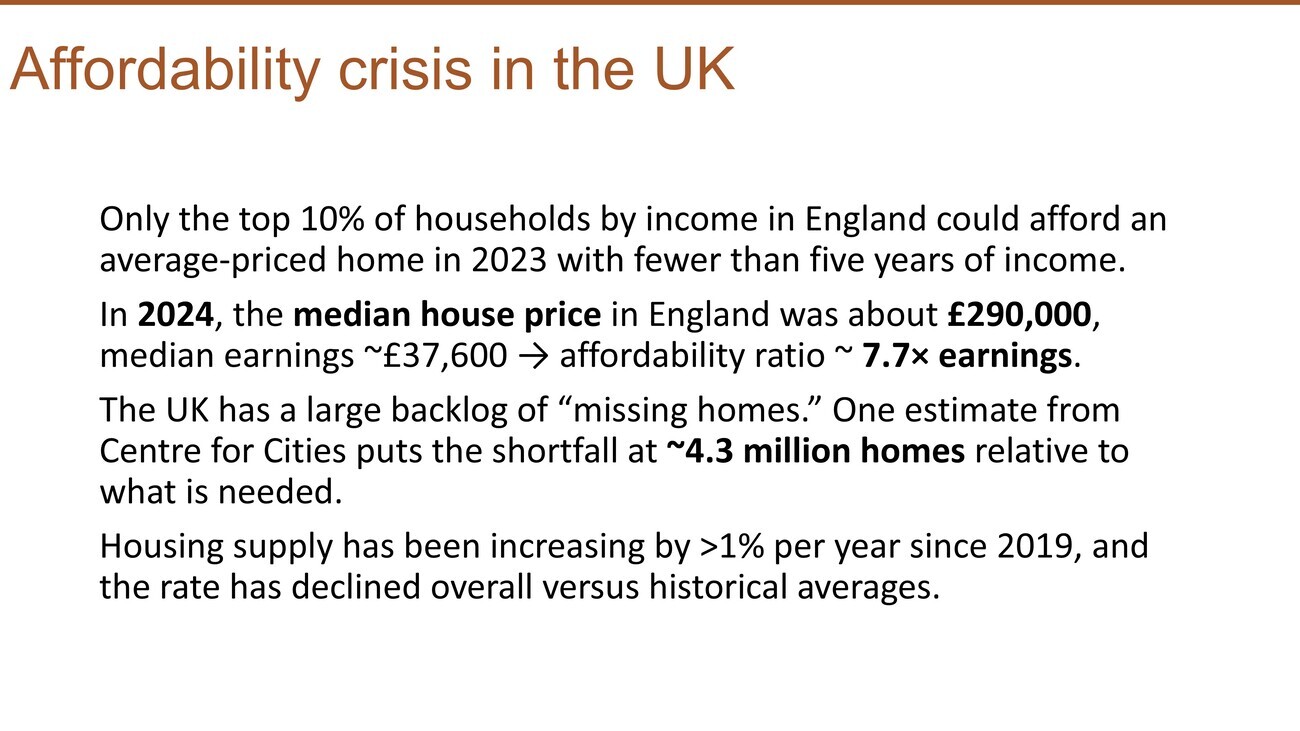
Right now, in England the average household is really far from being able to afford a home. In 2024, it took about seven years of average earnings to buy a home, and the simple explanation for this, as they see it, is a sheer supply shortage. They need about 300,000 homes a year just to maintain the current ratio of homes to people, but the country’s been failing to meet that threshold for several decades now and they have a backlog that’s estimated at about 4.3 million missing homes.
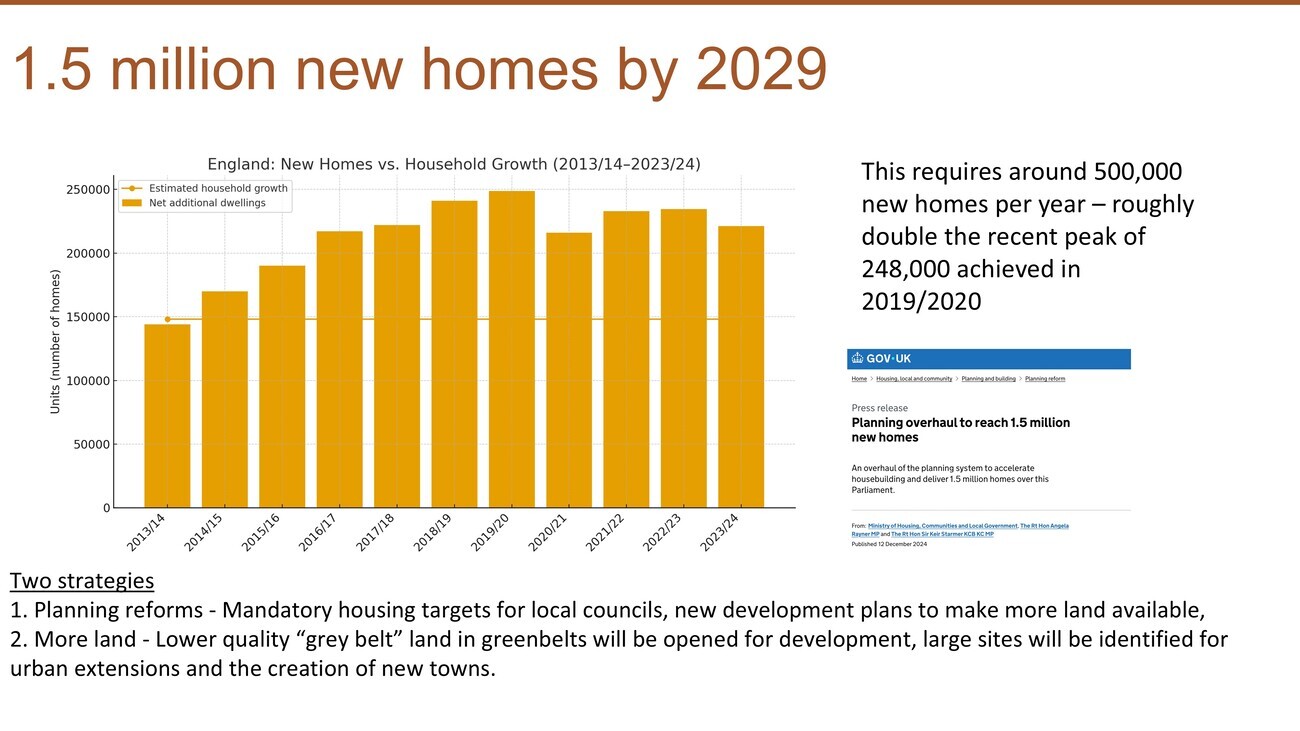
To start addressing this, the new Labour government of Keir Starmer has set a goal of building around 1,5 million new homes by 2029, which is when the next parliamentary elections are scheduled. And to do this, they need to roughly double the production that was achieved in the recent peak year which was 2019-2020, and they have two strategies to do this.
- First strategy: Like all the Anglophone countries, the UK has recognized that their planning systems have become an unmanageable obstacle to growth with excessive local control, leading to cancellations of worthy projects, restrictions on densification, and some class and race-based efforts to keep people out of existing communities. And actually the efforts to reduce that regulatory burden have proven politically unpalatable. So the government is instead pushing the issue downward by requiring local councils to permit a certain number of units every year and supporting that effort with more resources for planning. So that’s their version of planning reforms.
- The second strategy is about land, increasing the supply of urbanisable land, identifying land in their greenbelts, or other preserved land that may actually not be worth preserving, which they call “greybelt land”, and seeking larger sites around the country where they can create these new towns.
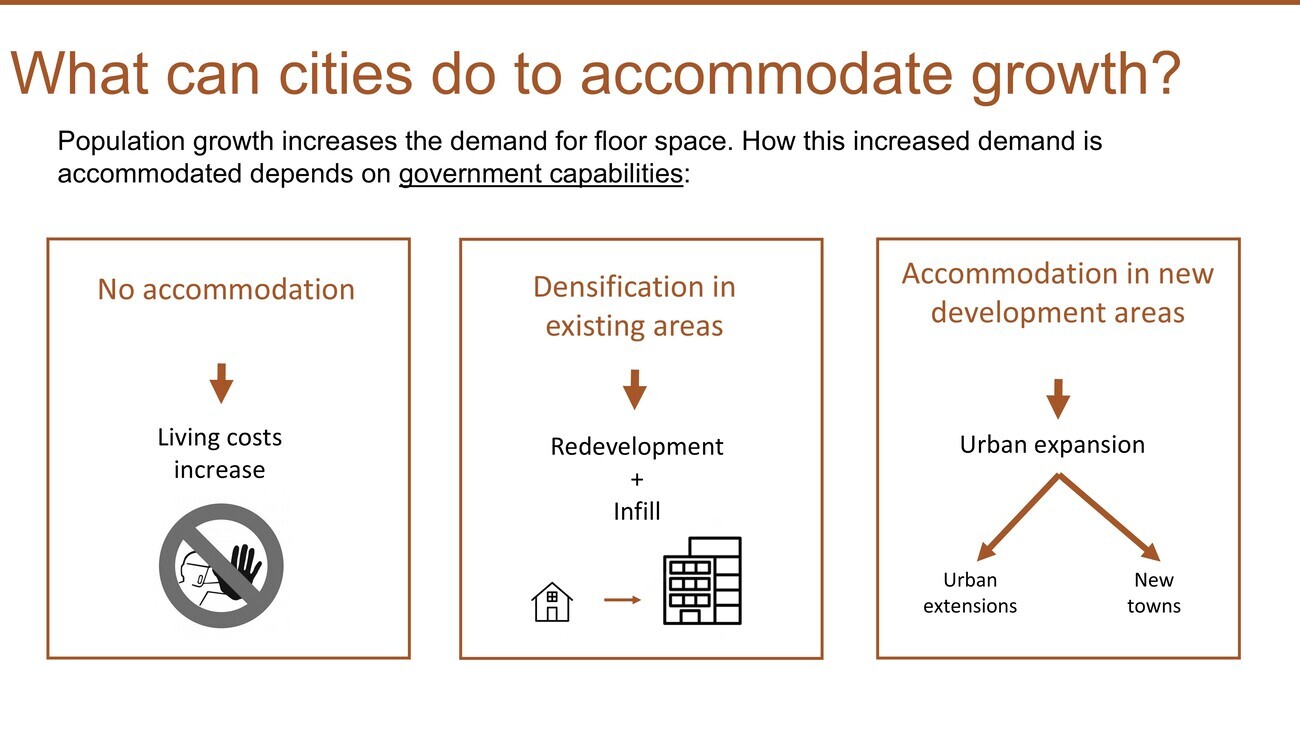
We all know that as cities add population, the demand for floor space, meaning space in buildings, increases, and the strategy in the UK addresses the two options that cities have to accommodate this growth.
You can accommodate growth within the existing area of the city through infilling, which can happen through building on vacant parcels or through vacant spaces on parcels.
The second approach is to accommodate growth in new areas of development on greenfield land, and that can look like urban extensions where you’re growing the existing area of the city or it can look like new towns which attempt to establish new urban centres as we’ve already discussed.
The third option is what the UK has basically been doing: you don’t make room for growth, not really, and when you do that you don’t have to deal with any of the negative externalities of development but the empirical data makes it pretty clear that this leads to out-of-control living costs.
2 12 new towns
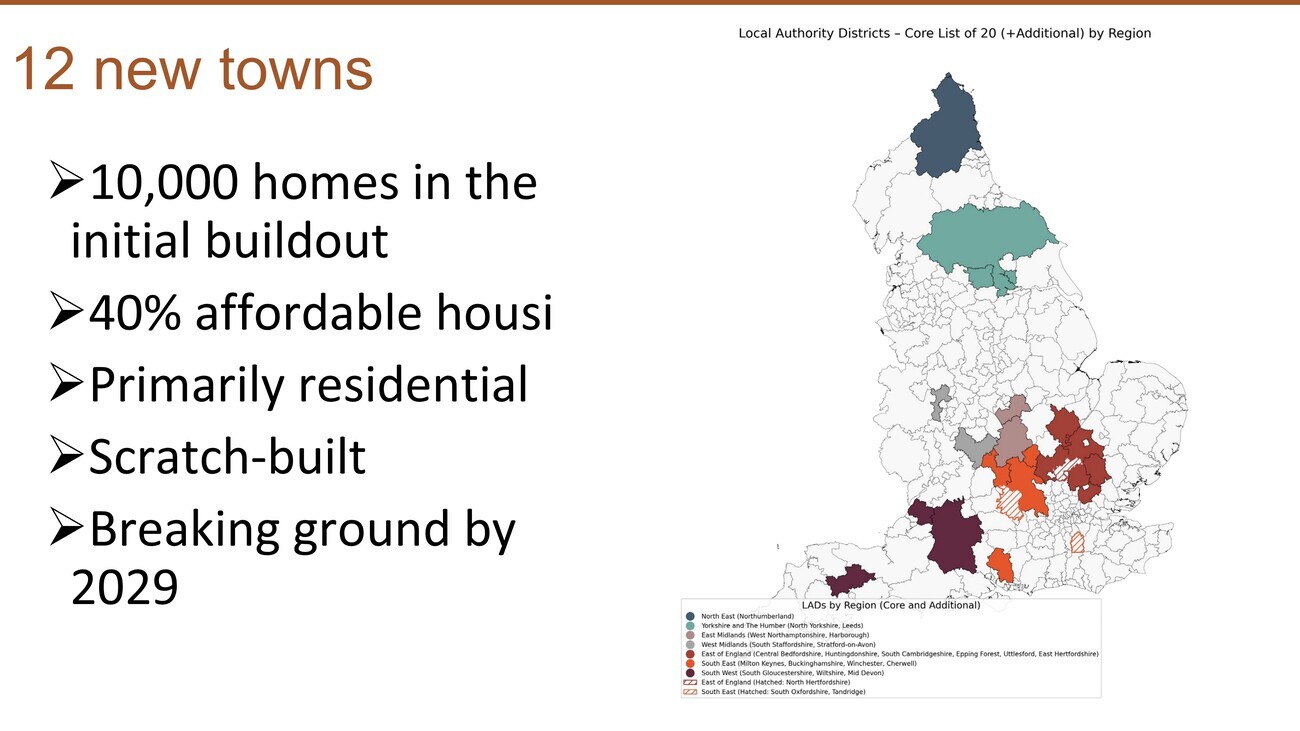
The UK strategy includes the construction of 12 new towns, and the image here shows the proposed locations that were presented in a recent report by a UK consultancy. The final report from the UK government hasn’t been released yet. These towns have a target of at least 10,000 homes in the initial build-out with 40% allocated to affordable housing, although they haven’t defined exactly what that means yet.
The towns will be primarily residential, and they’ll be built from scratch on large pieces of vacant land. Although they initially were hoping that these towns could contribute to their 1,5 million homes target, they’re now saying that they will try to break ground by 2029, by the end of the parliamentary period.
It’s not the first time that the UK has done new towns, they built at least 15 new ones after World War II, partly to address the desire for modern living but mostly because of a housing shortage that was caused by German bombing. These new towns targeted an initial population of about 700,000 people and they were built by the government, similar to I think what happened in France.
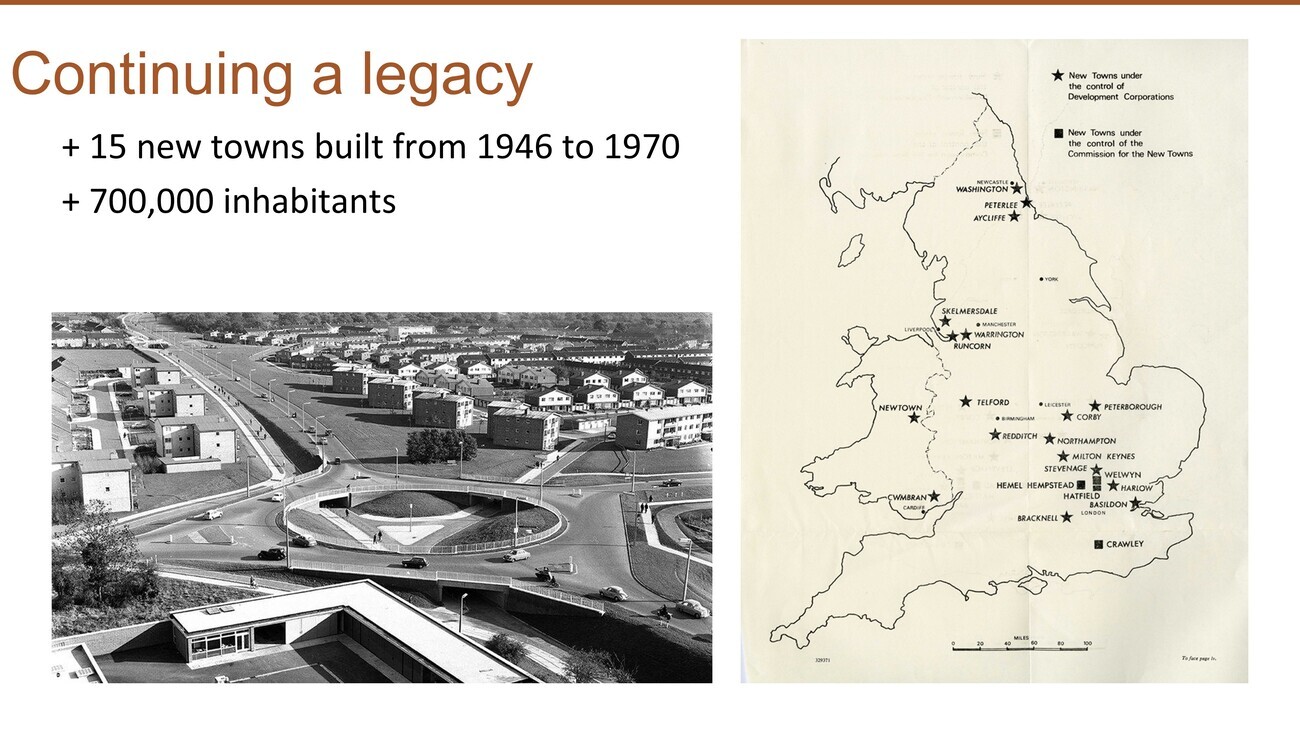
Now the new generation of new towns is a bit less ambitious, the initial target is around 360,000 people, but we can learn a bit from the older generation. They were very exciting at the time, but as the previous speaker was illustrating, they suffered from problems that also were experienced in France: lack of demand, over-design, low density, car dependence. They also had an over-emphasis on housing rather than jobs, and as they got older, they suffered a legacy problem, because everything was built at the same time, the modern designs and the master planning didn’t leave room for the evolution of the place, and it made everything pretty quickly look dated.
Building these new towns is really expensive. The estimated cost is over 4 billion euros each, which comes around to 460,000 euros a home approximately, when everything’s averaged in, which is a lot more than you’d pay in the private market, even in the UK. And to get the work done, they plan to create these New Town Development Corporations that can issue loans backed by the government.
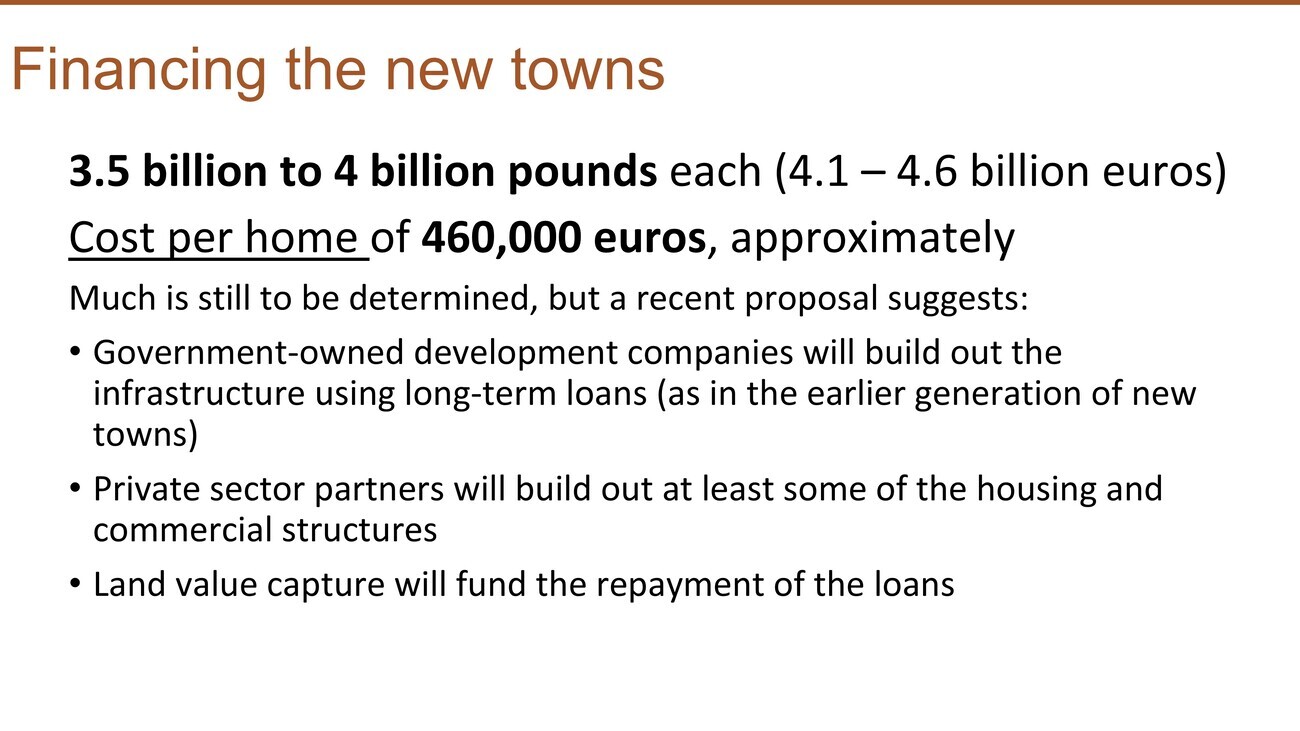
In the early generation of new towns, these corporations built out the structures, the commercial and residential buildings, as well as the infrastructure, but in today’s new towns, they are thinking of a hybrid approach, where government funds build out the infrastructure and private sector partners will build out the housing and commercial structures, or at least the ones that aren’t tagged as the 40% affordable.
When new infrastructure is brought online in a rural area, the value of the land increases a lot, and the plan is to pay back the loans by capturing a portion of this land value increase, which actually is what they did in the older generation of new towns, and it worked pretty well.
3 4 key questions
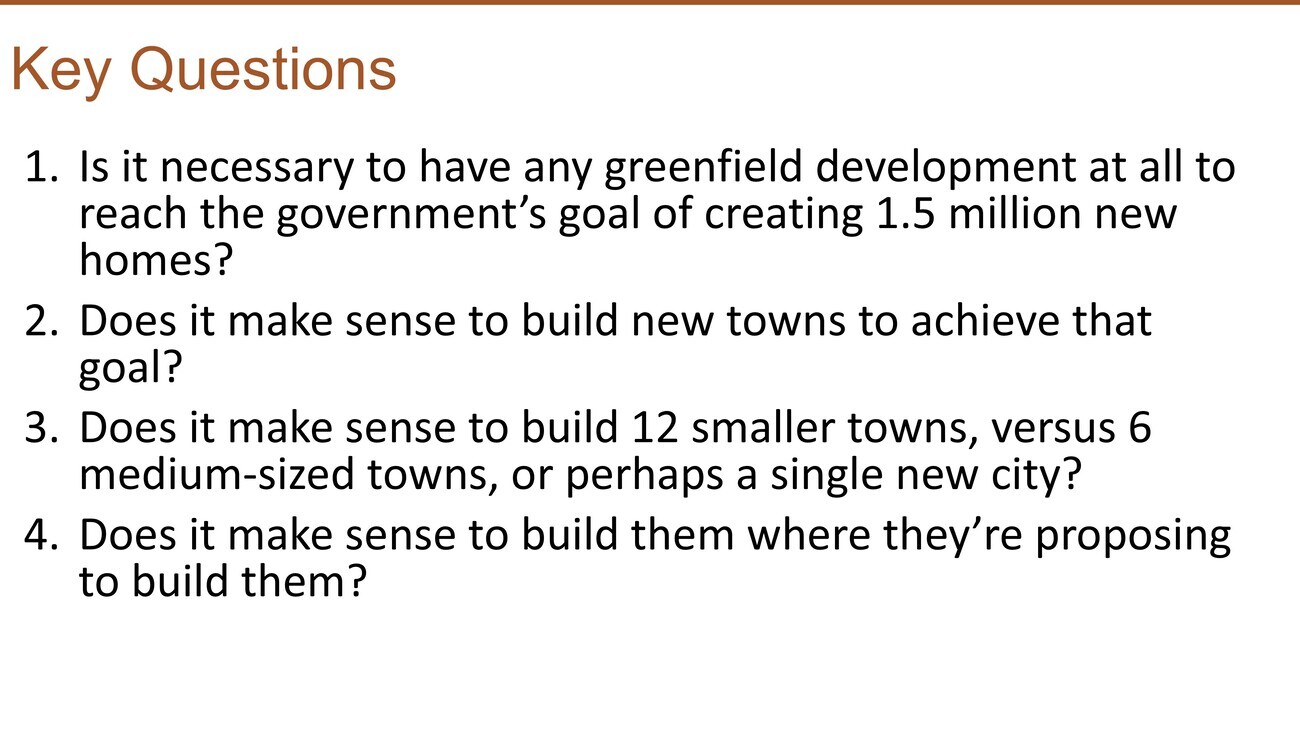
So public policies are subject to public debate, and I think it’s interesting to interrogate the new towns program with a few questions.
3.1 Is it necessary to have any greenfield development at all to reach the government’s goal of creating 1.5 million new homes?
The first question is whether it’s actually necessary to have any greenfield development at all: would it be possible theoretically to meet the need for new homes in the UK entirely through densification and infill in existing cities?
And the data seems pretty clear. With a 4.3 million home shortfall, the country has added somewhere between 26,000 and 135,000 units a year through infilling, and at that pace it would take 32 years to wipe out the backlog if they could stay at the peak, which they’re not.
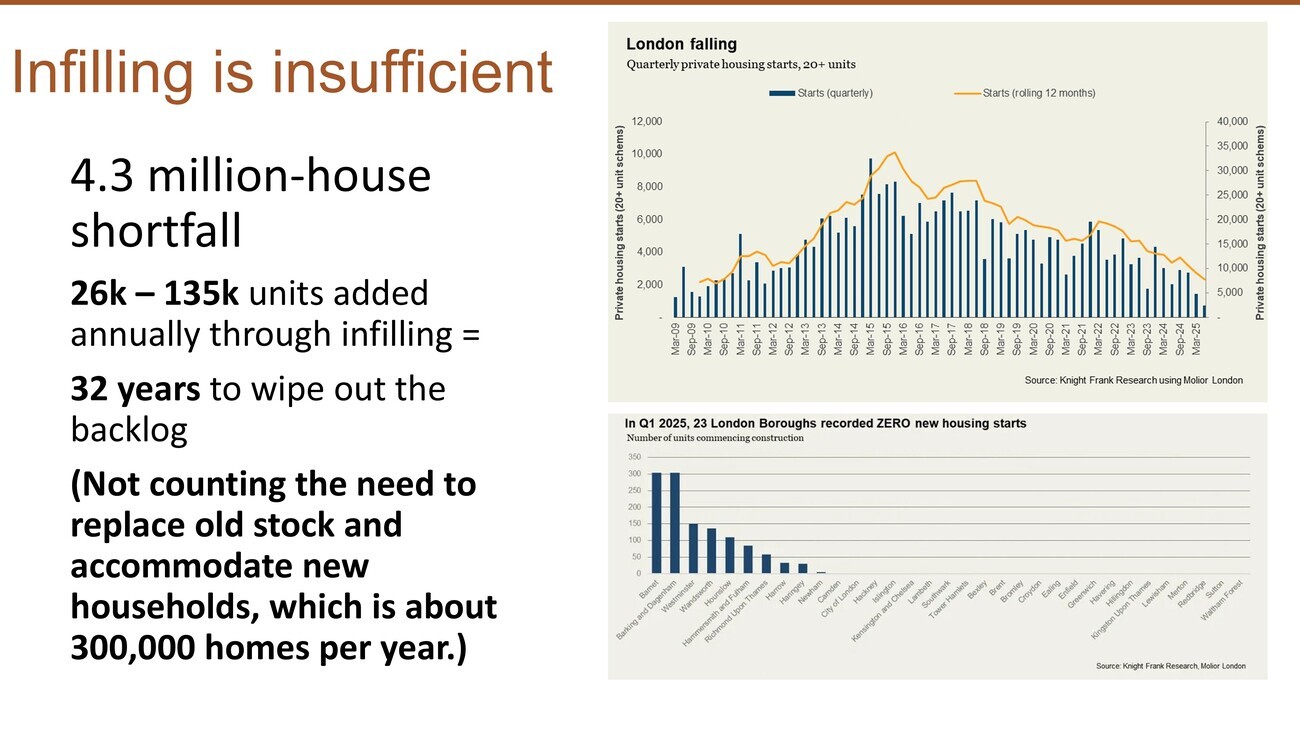
But we have to keep in mind that they also need to add about 300,000 homes a year just to keep up with population growth and the replacement of dilapidated stock. And to make matters worse, they’re headed in the wrong direction. Infilling in major cities like London has actually been in decline. For example, we see that in Q1 of 2025, 23 of London’s boroughs recorded zero new housing starts, meaning they’re not producing new housing. So it seems pretty unlikely that infill is going to get the UK to where it needs to be in any kind of a reasonable time frame.
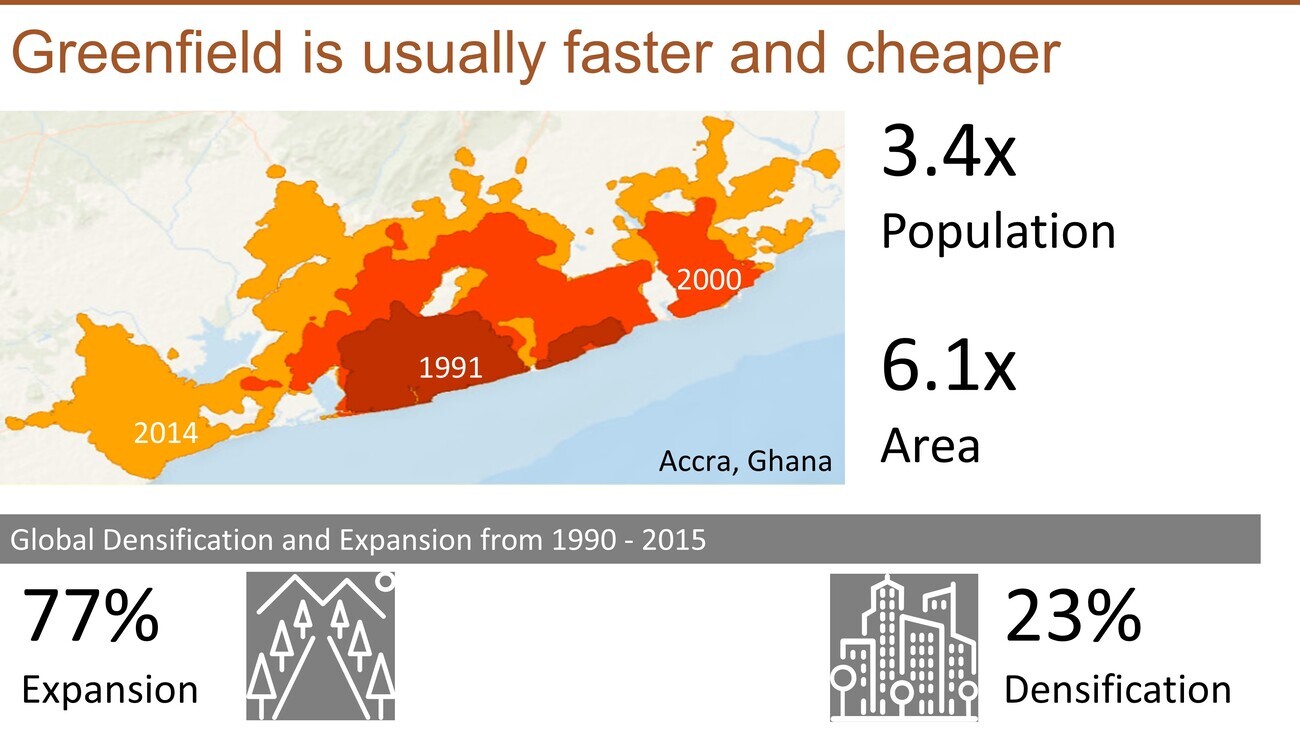
So why can’t infill compete with greenfield in this case? In low-affordability markets, you know, where affordability is a big issue, most of the cost of the home is the cost of the land. The share of the house price that’s the cost of the land goes up and up and up. And land is cheaper on the urban periphery than it is in the urban core. So when we look at this globally, we see that around 77% of urban population growth is accommodated in peripheral areas, and only about 23% accommodated through infill and densification.
Now, one reason for this is obvious. There’s just a limited supply of available land within the existing cities. And it’s not all on the market at the same time. So the potential for greenfield development is always greater, and the cost of land is almost always lower.
Now, greenfield development is also faster. There are fewer neighbors to make objections, there are usually fewer regulations, there’s no need to acquire and demolish buildings or to remediate hazards in the case of brownfield sites, and it all amounts to a faster, lower-priced home building process.
So, say that you accept the idea that there needs to be greenfield development.
3.2 Does it make sense for the UK to use new towns to achieve that goal versus urban extensions?
So first, let’s keep in mind that these new towns are fairly small. In general, in most urbanized countries, the tendency is away from small towns, big cities are growing, and smaller cities and towns are not growing or not growing as fast. In England, it’s a little different. Small towns and medium-sized cities are both growing faster than average in England, but that seems to be mostly due to underproduction of housing in big cities.
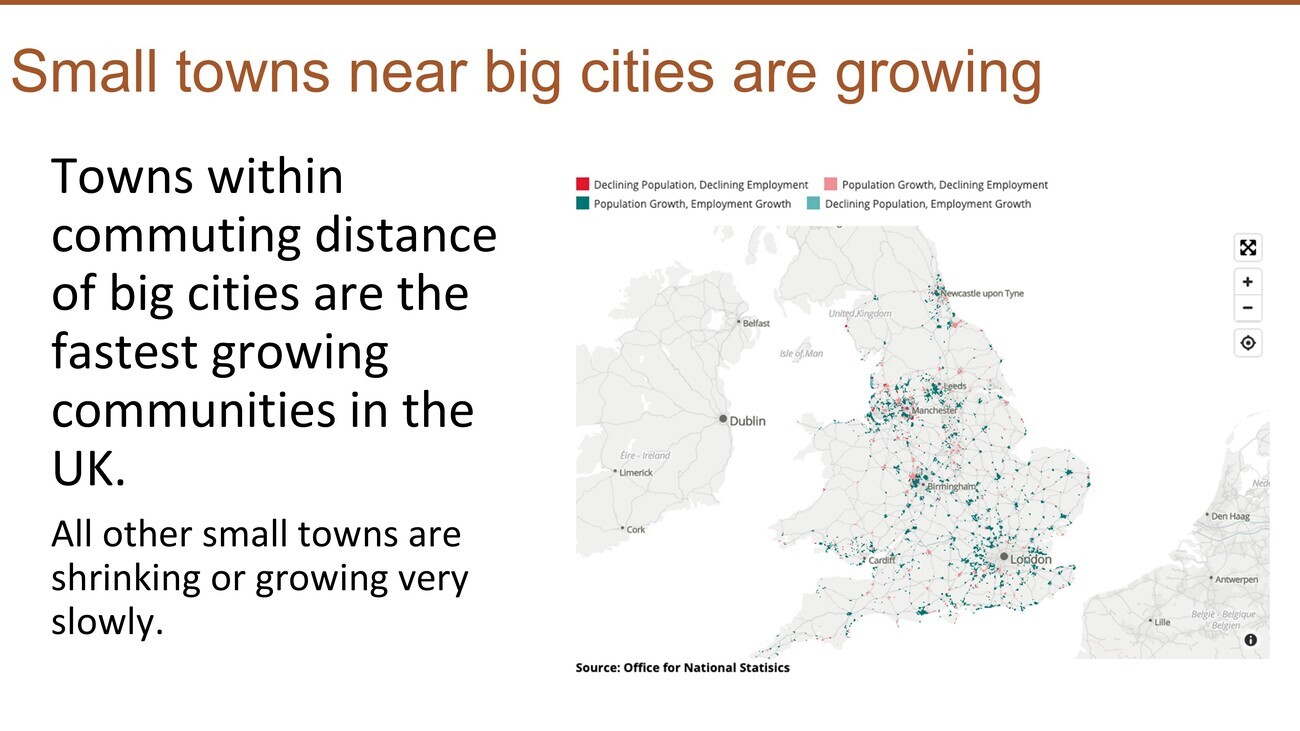
This map shows the places where they’re adding jobs or adding people, and the distribution of growth is pretty clear. The small towns that are close to large cities and the large labour markets they represent are growing fast, and small towns that are rural or far from cities are either shrinking or growing slowly. So, in essence, some of the well-located small towns are being used as a substitute for urban extensions, and the government proposal here seeks to accelerate that trend. In that sense, it may be reasonable to build small towns in the south of England, for instance, provided they’re within commuting distance of a major city.
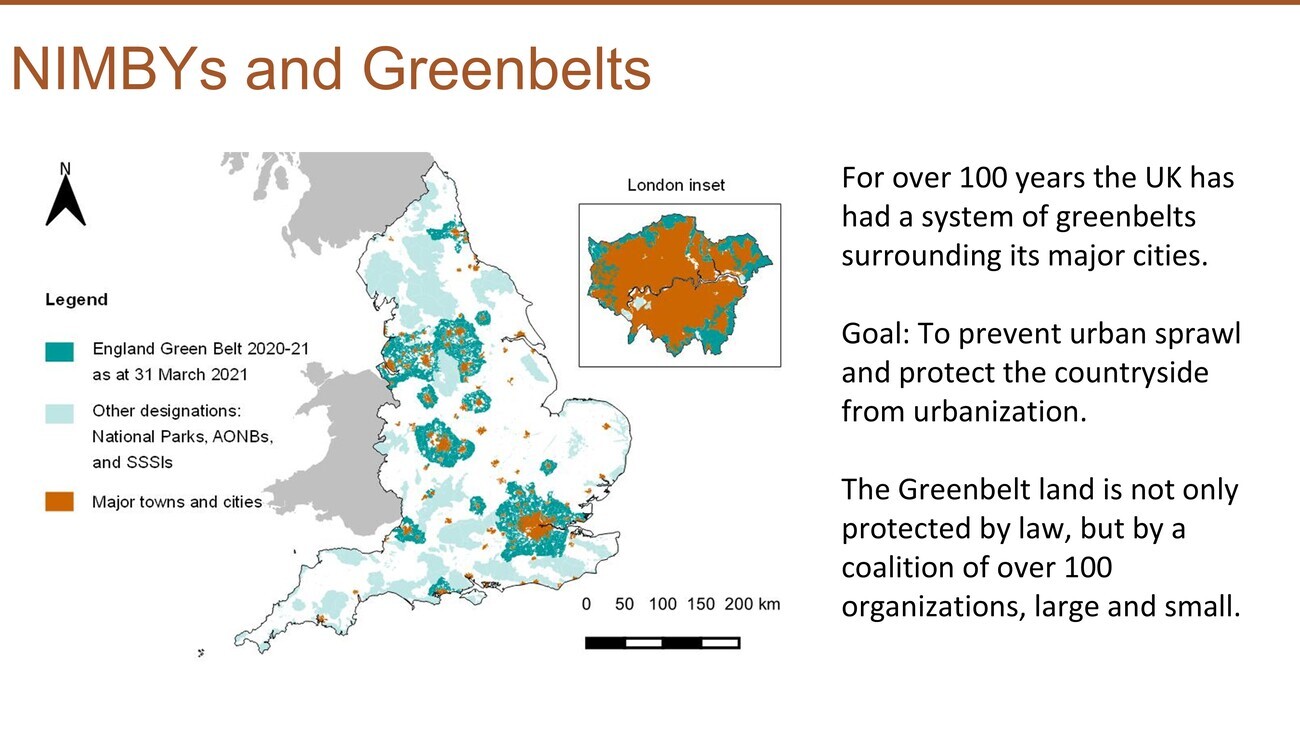
Now, another big part of the argument in favor of new towns is political. England has a strong culture of blocking development in existing areas using local privilege. So-called NIMBYs are a big part of the reason why London’s boroughs aren’t adding any housing. England also has a system of greenbelts, which you can see on the map here, which are basically large stretches of preserved land that encircle the major cities. And the explicit goal of these greenbelts is to check urban sprawl and protect the countryside from increasing urbanization.
Now, what does that mean in practice? First, it tells us that the greenbelt land is where the cities would be growing naturally without some kind of intervention. Otherwise, why the need to mobilize resources to protect it from development? Second, it means that the land in the greenbelt is not chosen based on what it is, it’s chosen based on where it is. So much of it is low-quality, degraded land, or land in agricultural use, and almost all of it is human-impacted in one way or another. It’s not natural areas that are being preserved.
Despite this, the London greenbelt, for example, is defended by a coalition of over a hundred organizations, some of them quite large, and changing it is going to be very difficult. Now, the small towns that are growing in the UK are often just outside the greenbelts. And when that happens, you can see what that does pretty clearly in this example. It’s an example that’s not from England, but from Seoul, South Korea. Seoul established its greenbelt in 1972, and for years, it had no effect on house prices because there was still lots of vacant land within the greenbelt boundary. But by the 1980s, the land in the greenbelt was basically exhausted, and house prices had started to rise very, very fast.
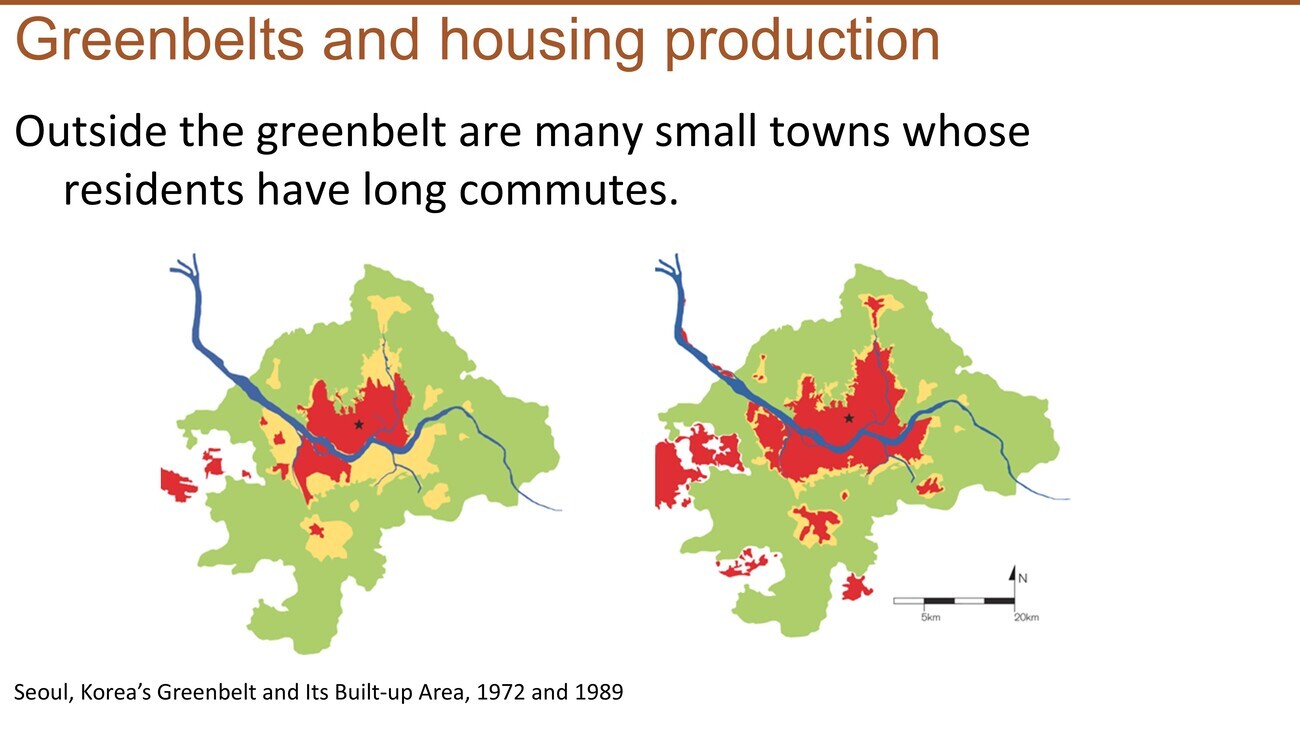
Now, so when that happened, rather than stopping growth, the greenbelt just pushed it away from the city into these new suburbs, forcing people to take longer commutes. And when you look at England, at London, you can see that the same thing has been happening there, where the main effect of the greenbelt has been to drive growth to small towns adjacent to London and other major cities as well. As a result, for example, the growth of London has become highly fragmented. Where before it was growing in a much more consolidated way, now it’s very fragmented, and this again forces people into longer commutes.
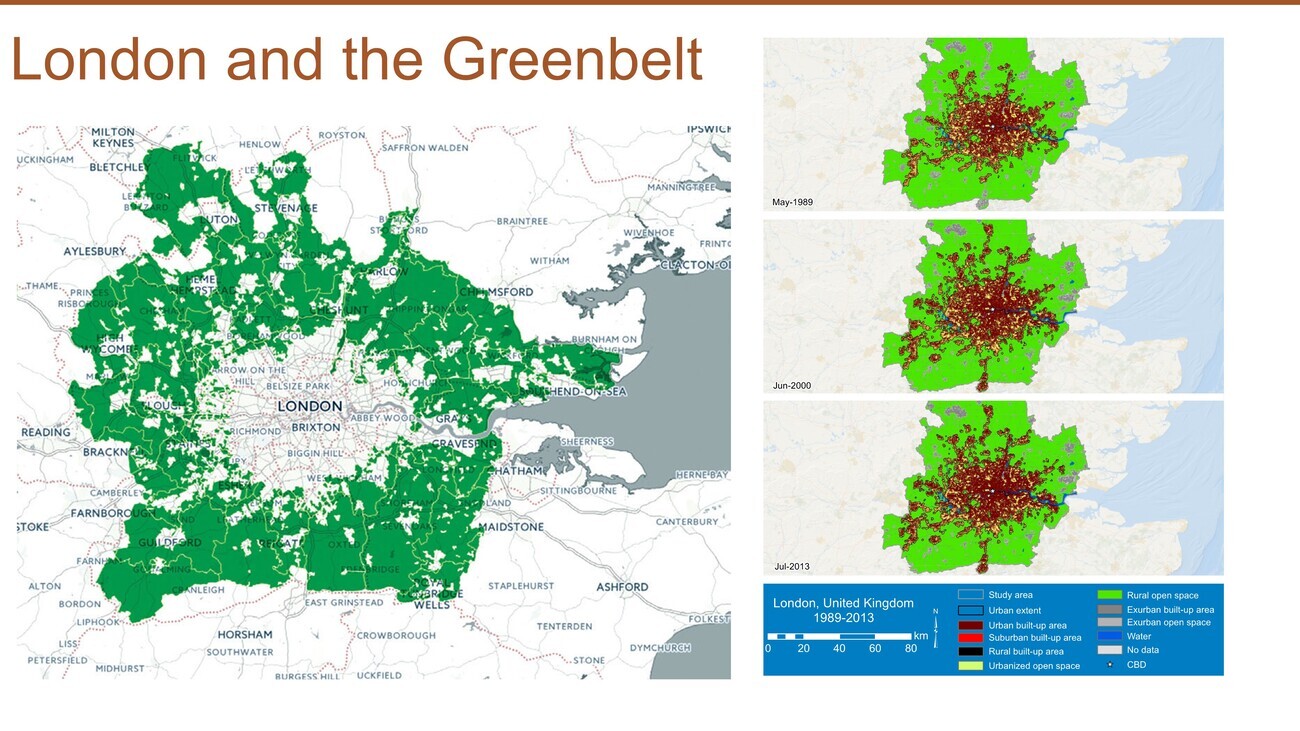
So in general, expanding small towns on the edge of greenbelts or creating new towns on the edges of greenbelts is a pretty inefficient way of solving the housing problem, because they settle people further in terms of geography and time than simply building urban extensions right up against the existing city.
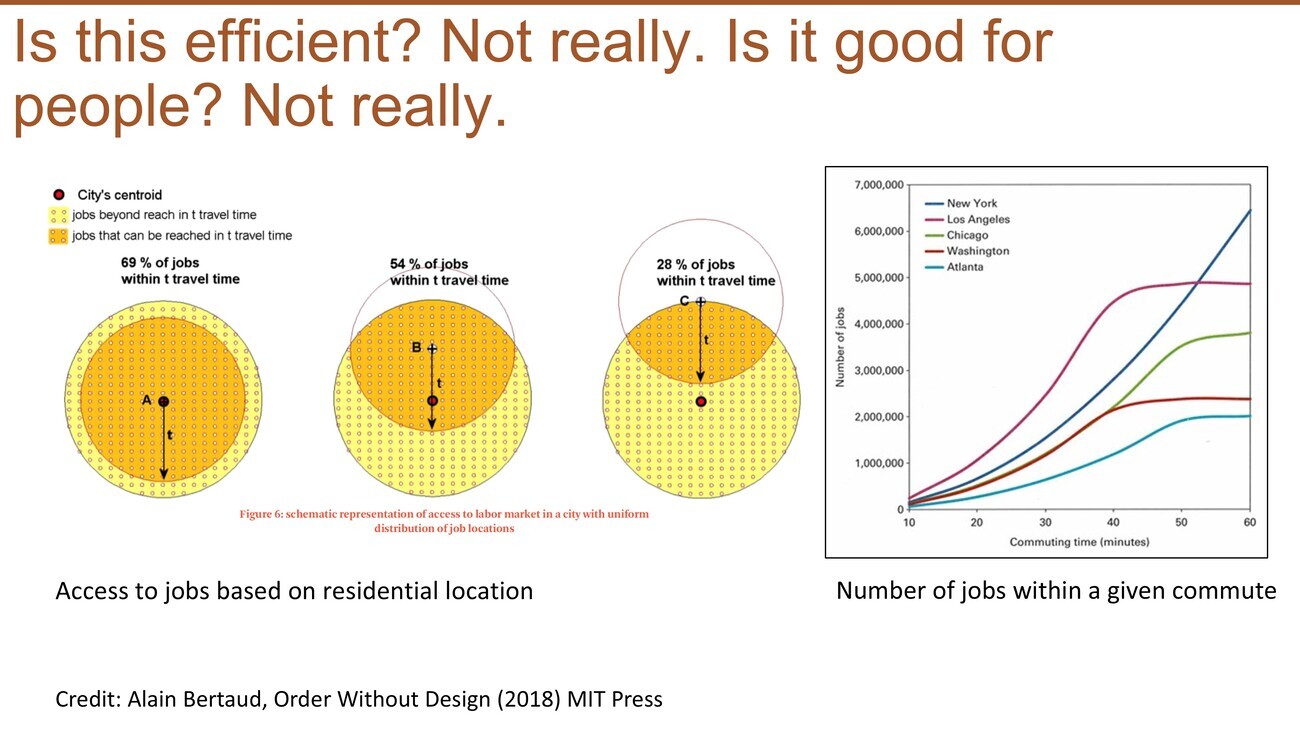
You can see in these diagrams here that the further you are from the center of a labour market, the lower the share of jobs you have access to.
3.3 Does it make sense to build 12 smaller towns, versus 6 medium-sized towns, or perhaps a single new city?
Say you need greenfield development for housing production, new towns do solve political problems, but why 12 instead of six or four or just one?
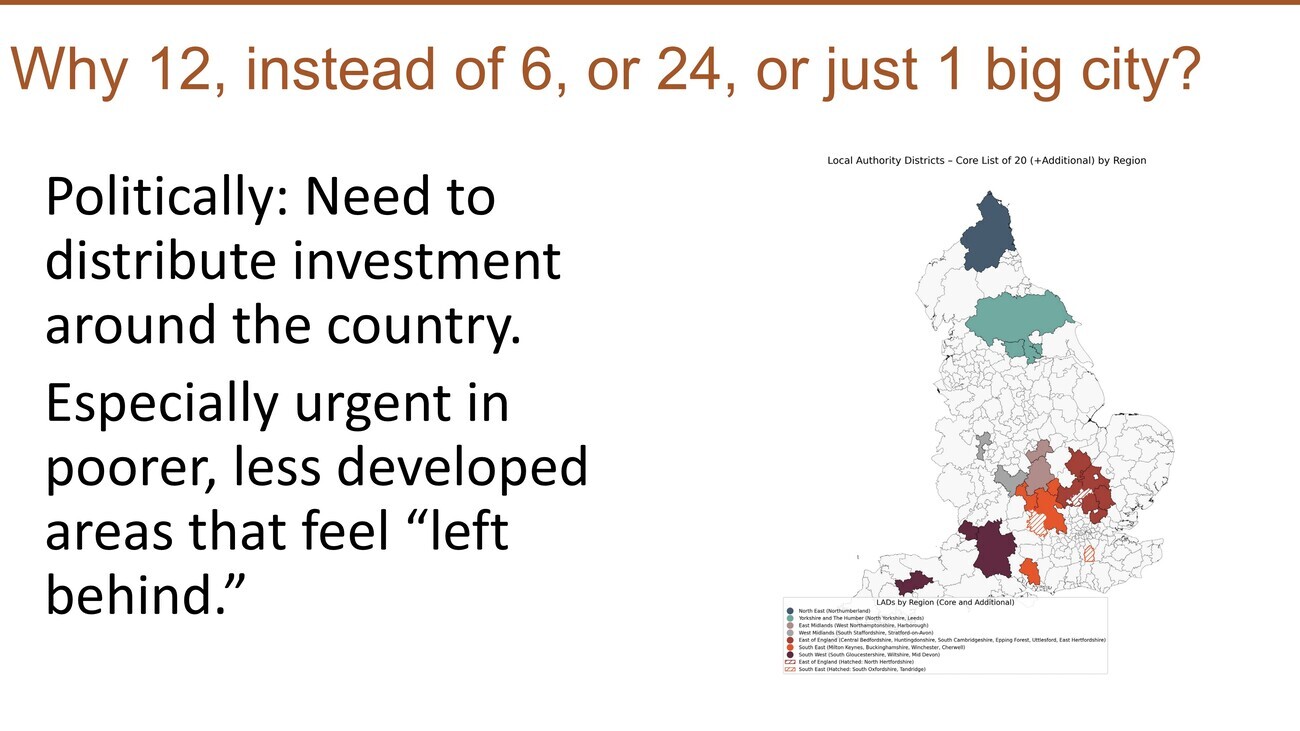
So as far as I could tell, the only argument for this is political. It lets the government distribute investment around the country, and especially in the poorer regions, that’s very important right now. But it does have this massive duplication of soft costs. It doesn’t make any sense operationally, because the proposed areas are underdeveloped and they don’t have any access infrastructure capacity. So it’s surely a more expensive way to do it.
And almost by definition, many of these proposed locations are in places that are under-connected and under-populated. So the overlap between road and rail networks and the sites is pretty minimal. And the improvements to connectivity are going to be very costly, and they could be non-strategic in terms of broader economic development needs.
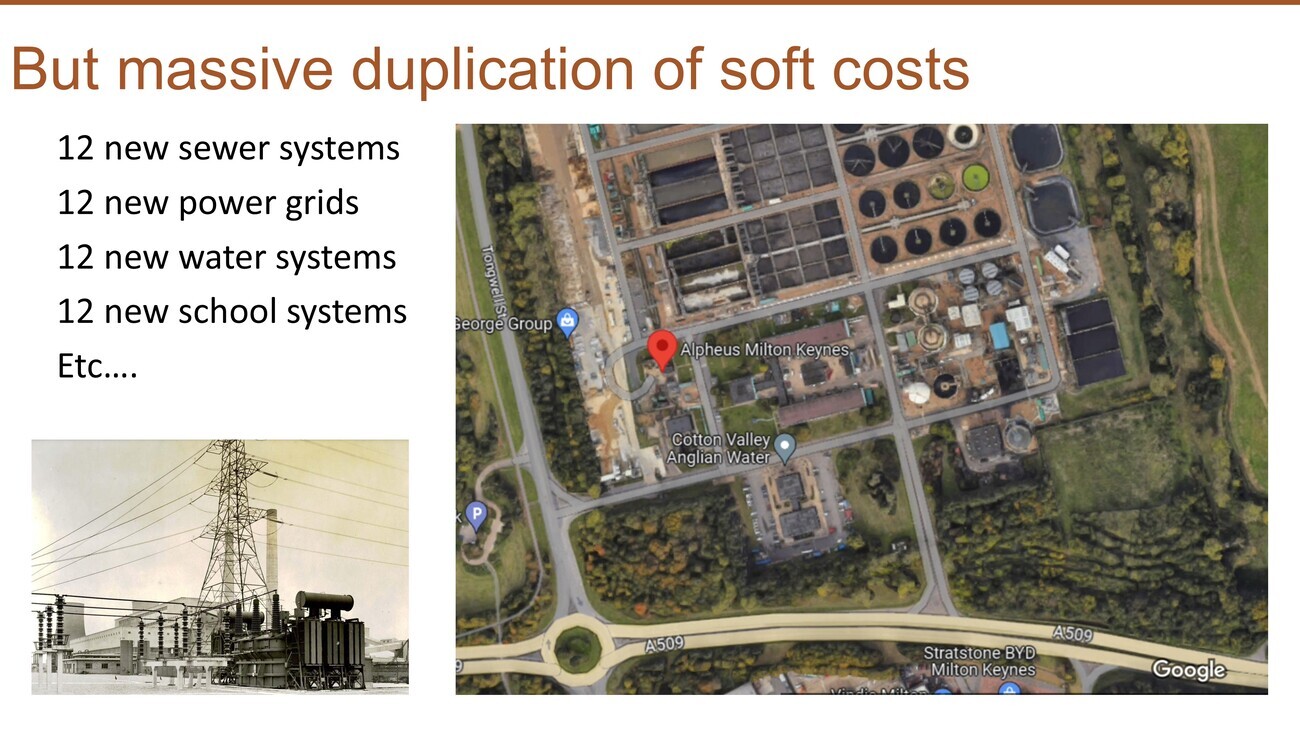
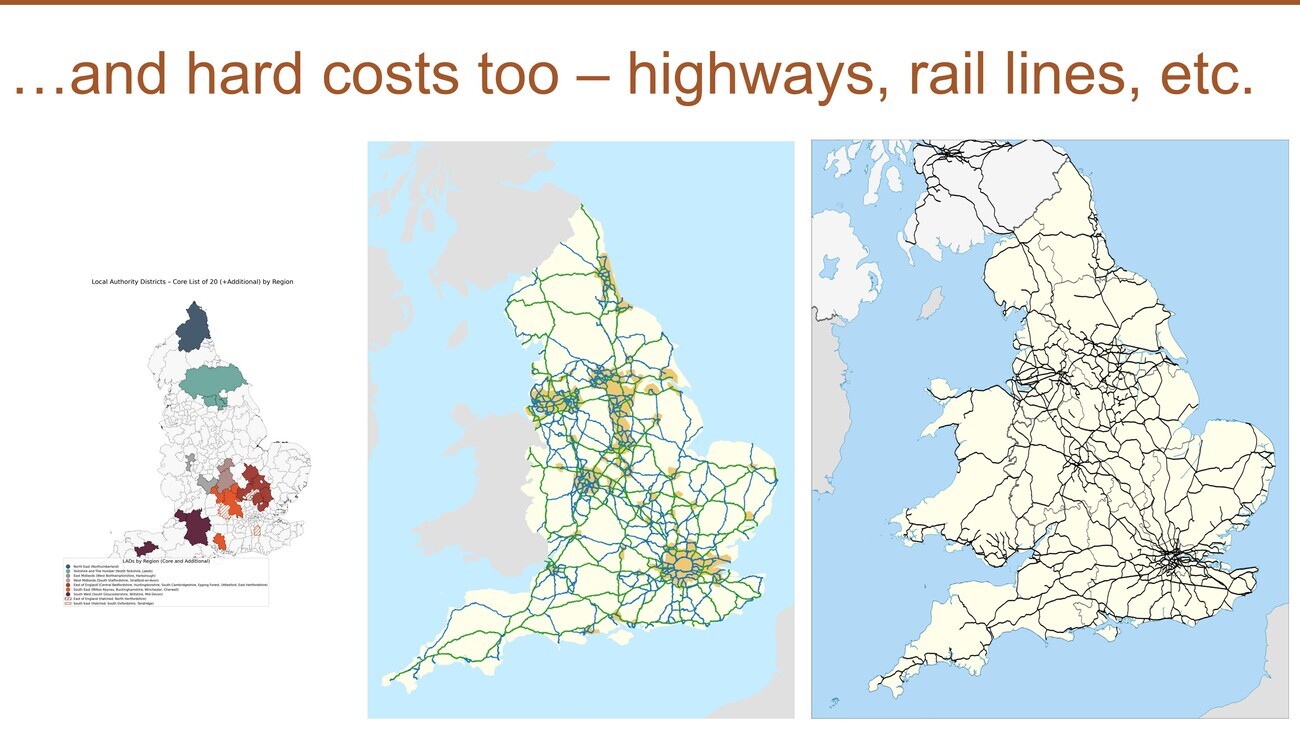
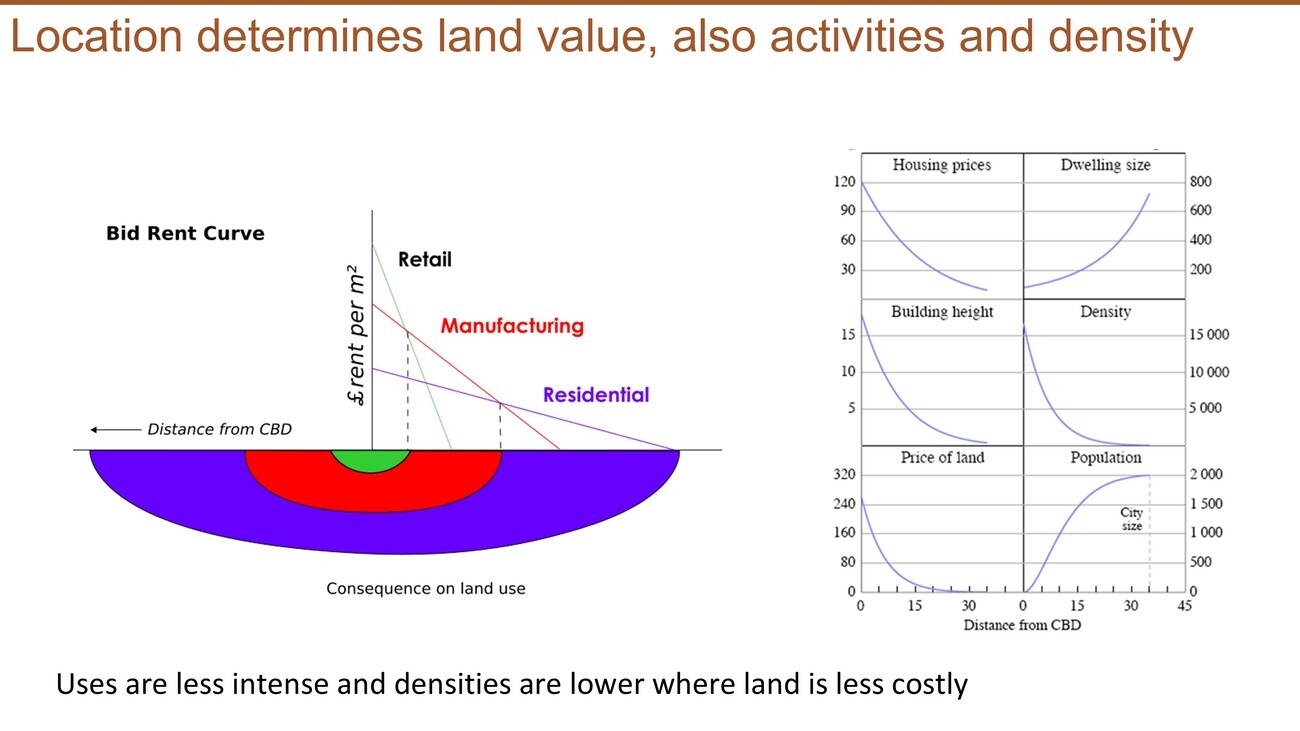
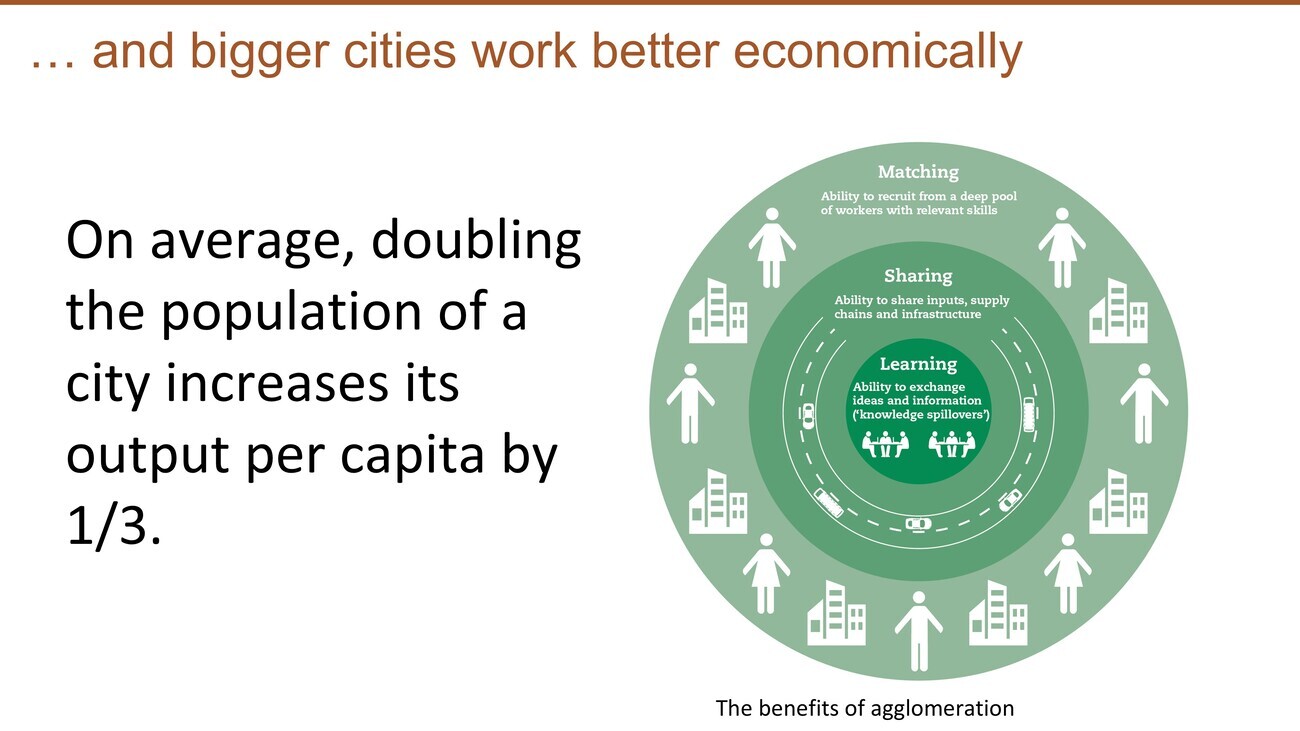
Now if the new towns are established, they’ll be smaller than if fewer were constructed. So they’ll have a less diverse labour force, likely lower levels of education, fewer employers, meaning less economic resilience, worse opportunities for education and leisure, less specialized health care, less culture, and so on. They won’t have a symphony for sure. By almost any metric except distance to open country, these will provide a lower quality of life than if they just grew a major city or built fewer of them.
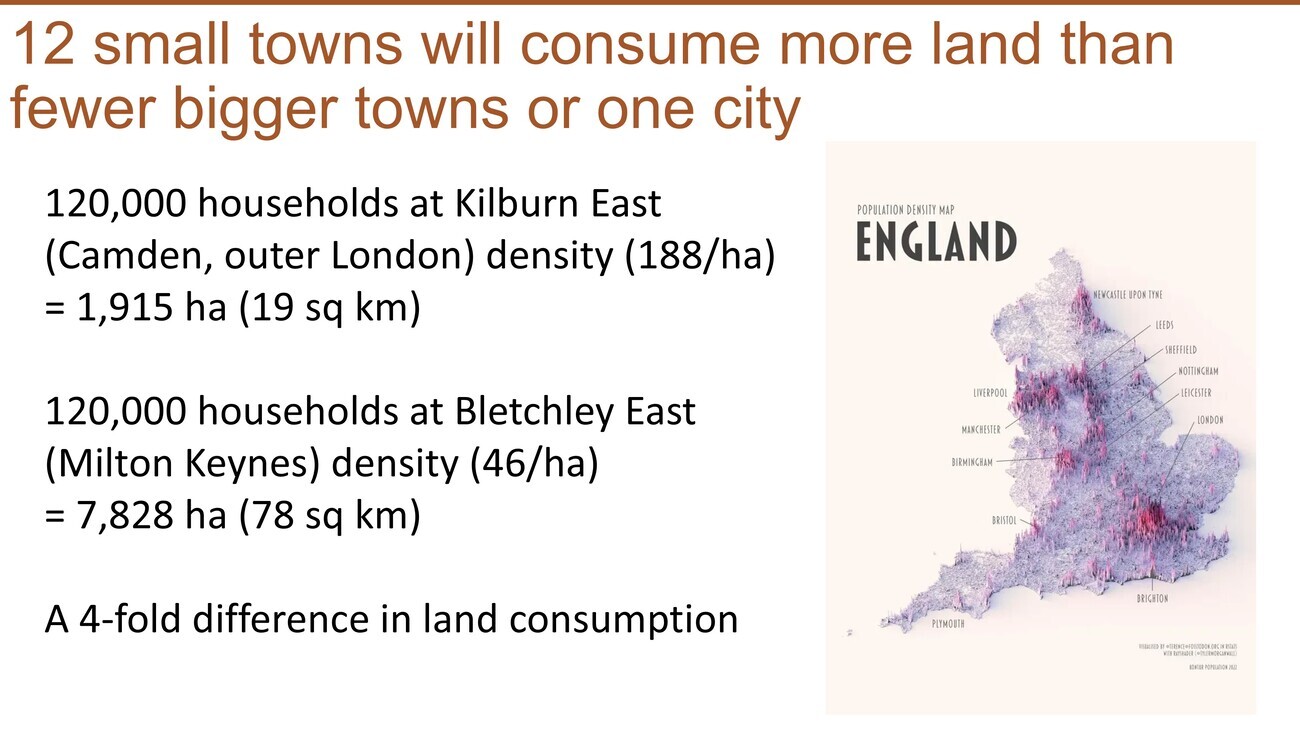
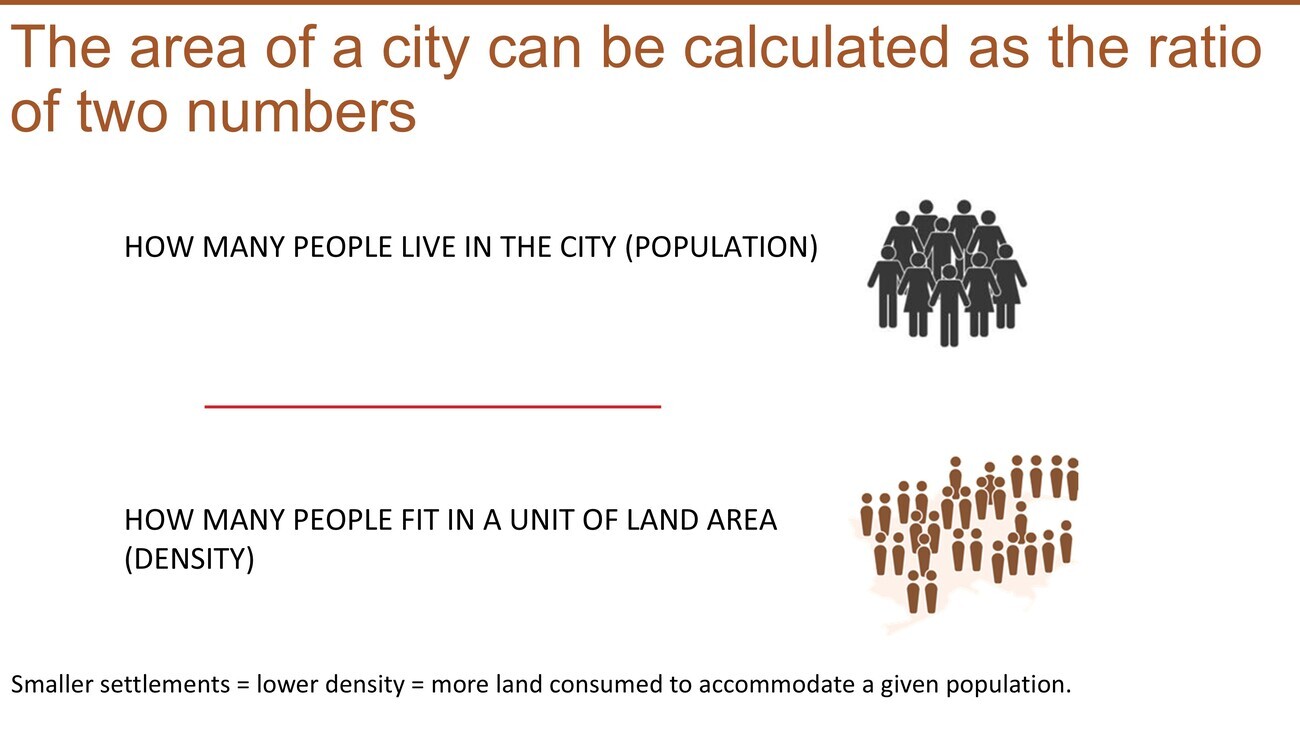
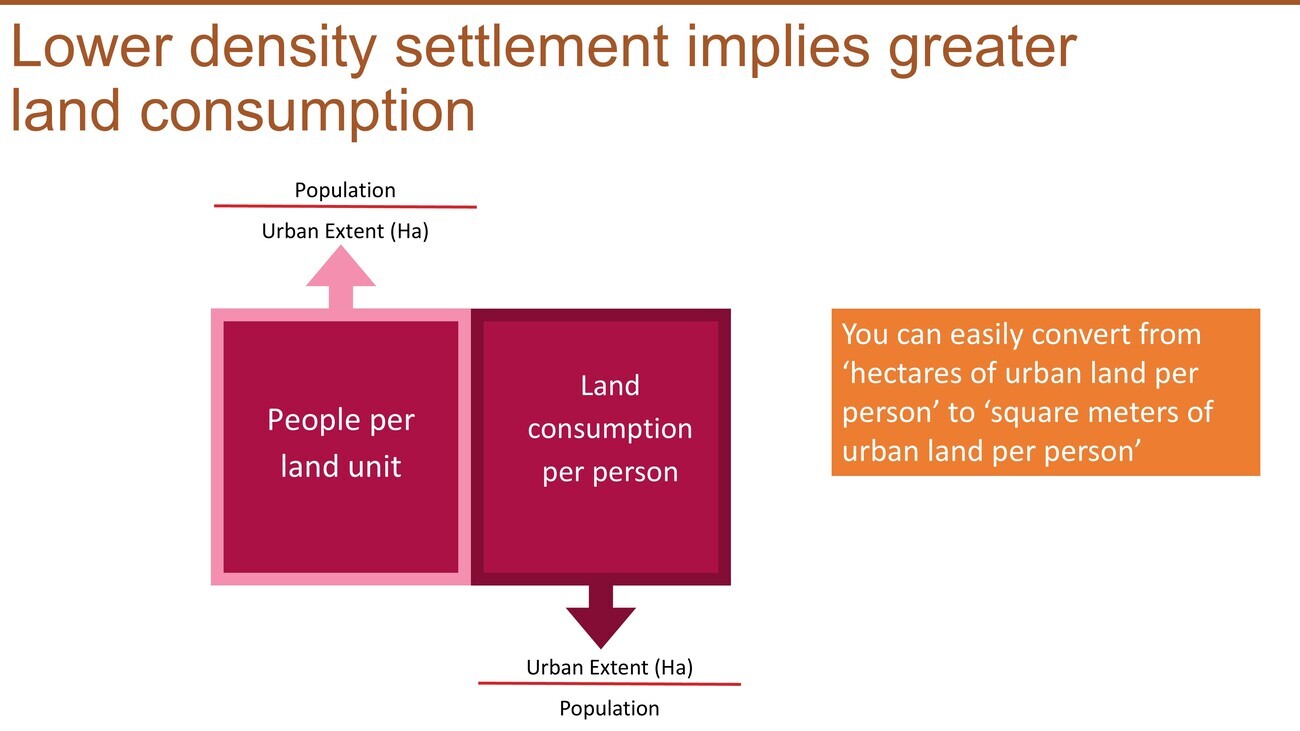
Another important point to consider is densities in smaller towns are lower than densities in bigger towns. So accommodating people in a larger number of small towns consumes more land than accommodating them in a smaller number of bigger towns or cities. For instance, if they built at roughly the density of East Camden here, then it would be possible for them to meet their 120,000 households goal in just 19 square kilometers. But if instead they do it at the density of an older new town, Milton Keynes, they’d need four times more land to accommodate the same number of people.
3.4 Does it make sense to build them where they’re proposing to build them?
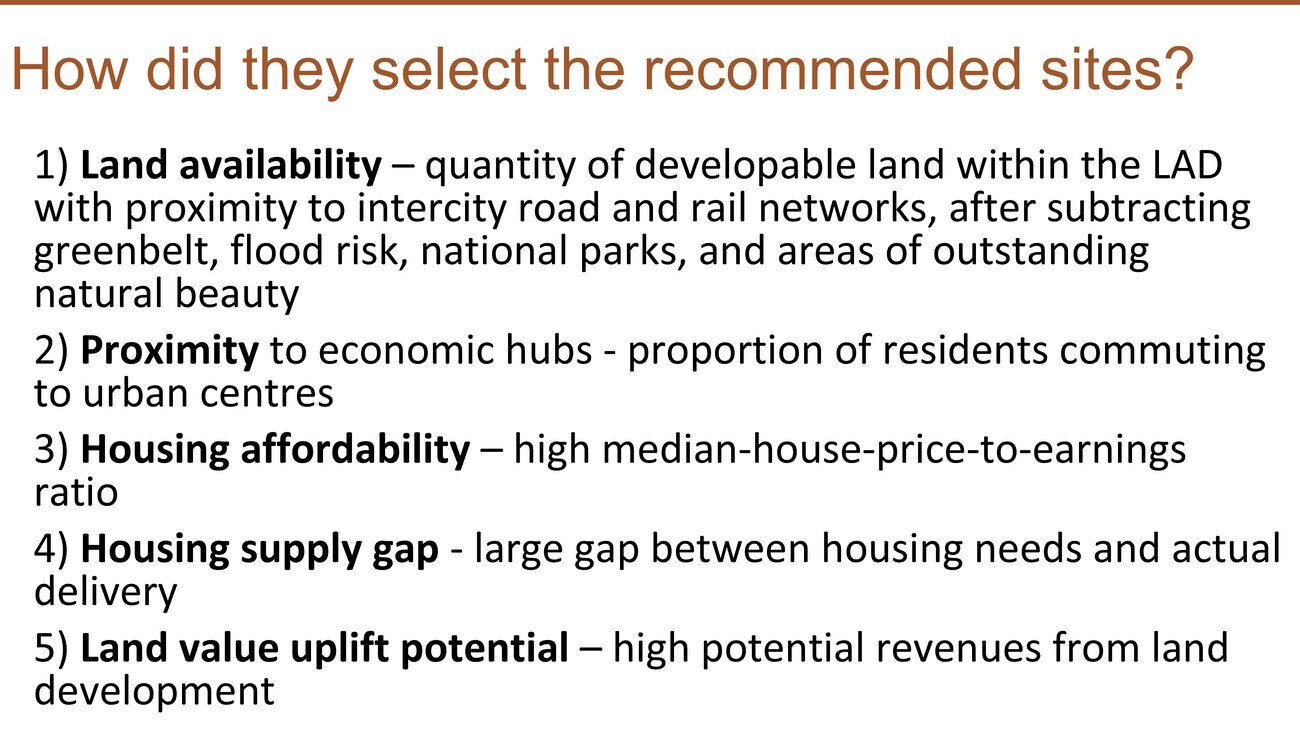
And basically they selected the proposed sites based on five criteria: land availability, proximity to economic hubs, housing affordability, the housing supply gap, and the land value uplift potential.
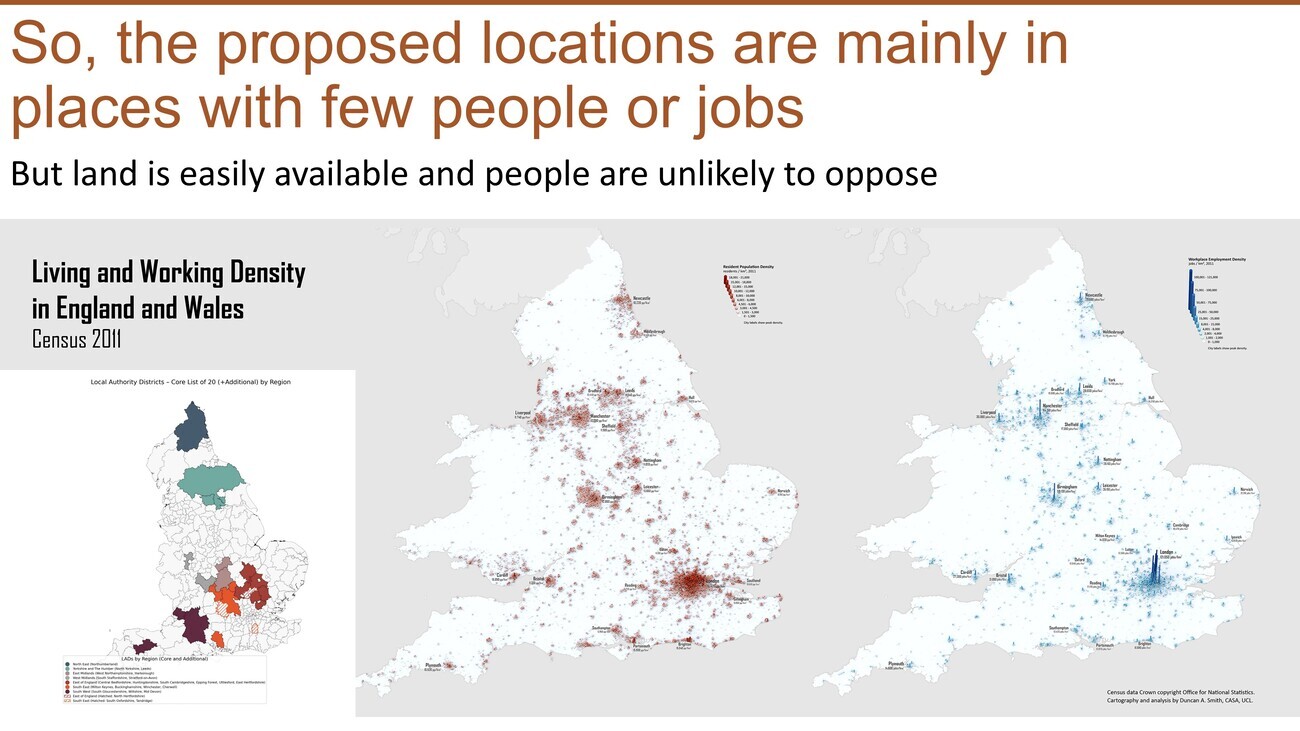
And what that means, consequently, is that the proposed locations are mainly in places with few people or jobs, places with no population or employment, based on the fact that land is easily accessible and the people who live there won’t be against it. But where people still have the option to commute. In fact, their only option for employment is to commute because there aren’t any jobs in the places that are recommended for the new towns.
Let’s entertain a thought experiment in an alternative way of solving the challenge of creating 1.5 million homes. The London greenbelt has 514,060 hectares. And Greater London, with a population of 8.9 million (2022) occupies 157,200 hectares and contains 3,532,342 homes. They average 22.5 homes per hectare in greater London. In other words, you could settle people at half the density of greater London, and still only require 133,333 hectares of greenbelt land to hit the government target of 1.5 million homes, and everyone would be within an easy commute of the prominent metropolitan and employment center in the country.
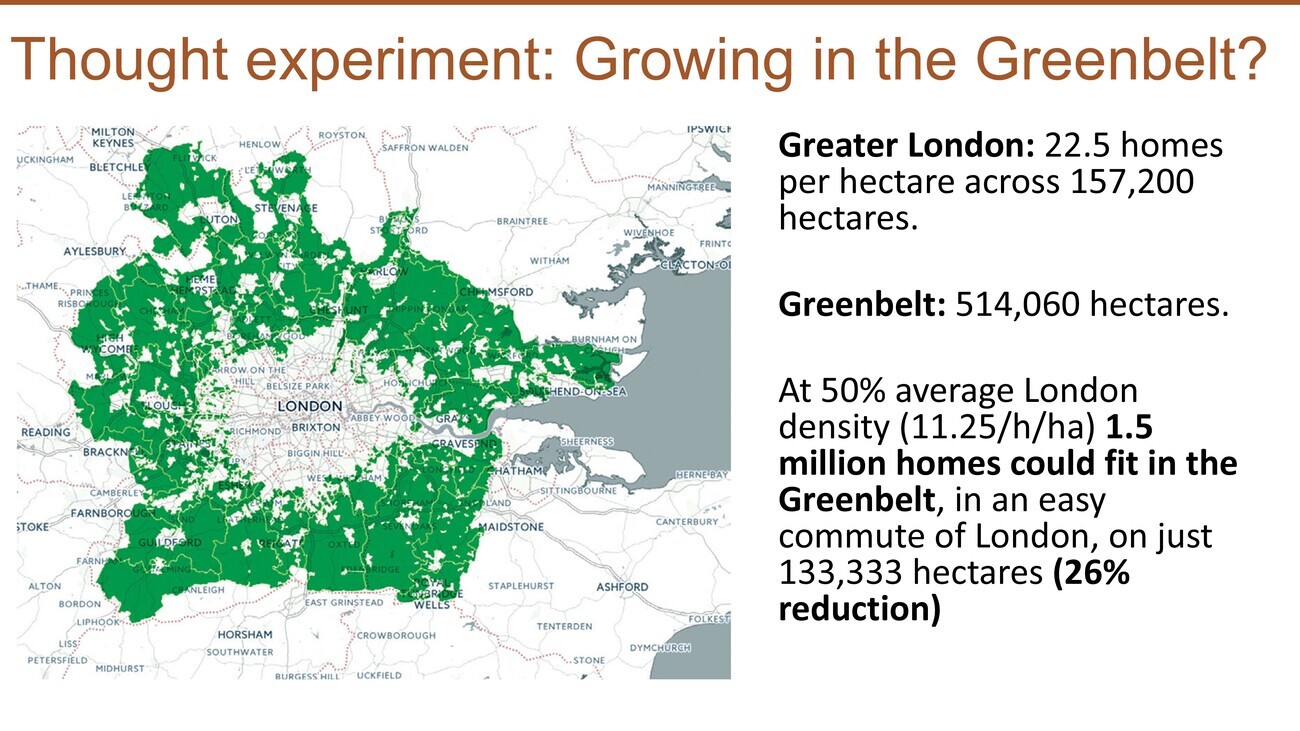
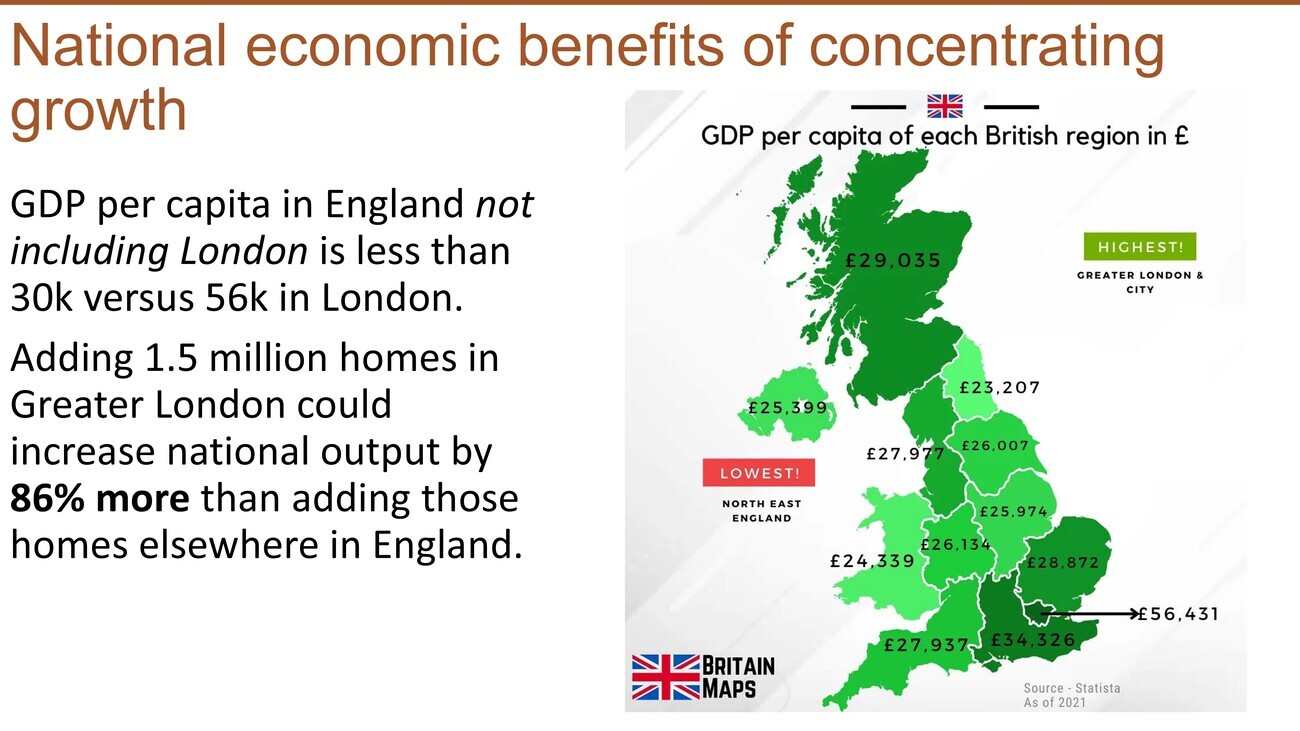
That 26% reduction in greenbelt land would have potentially major national economic benefits as well. GDP per capita in greater London is much, much higher than in the rest of the country. By placing people in that labor market, national output could be 86% higher than if you placed the same number of people anywhere else in England. That’s what England is leaving on the table in favor of NIMBYISM and greenbelt land of limited utility.
So, let’s review.
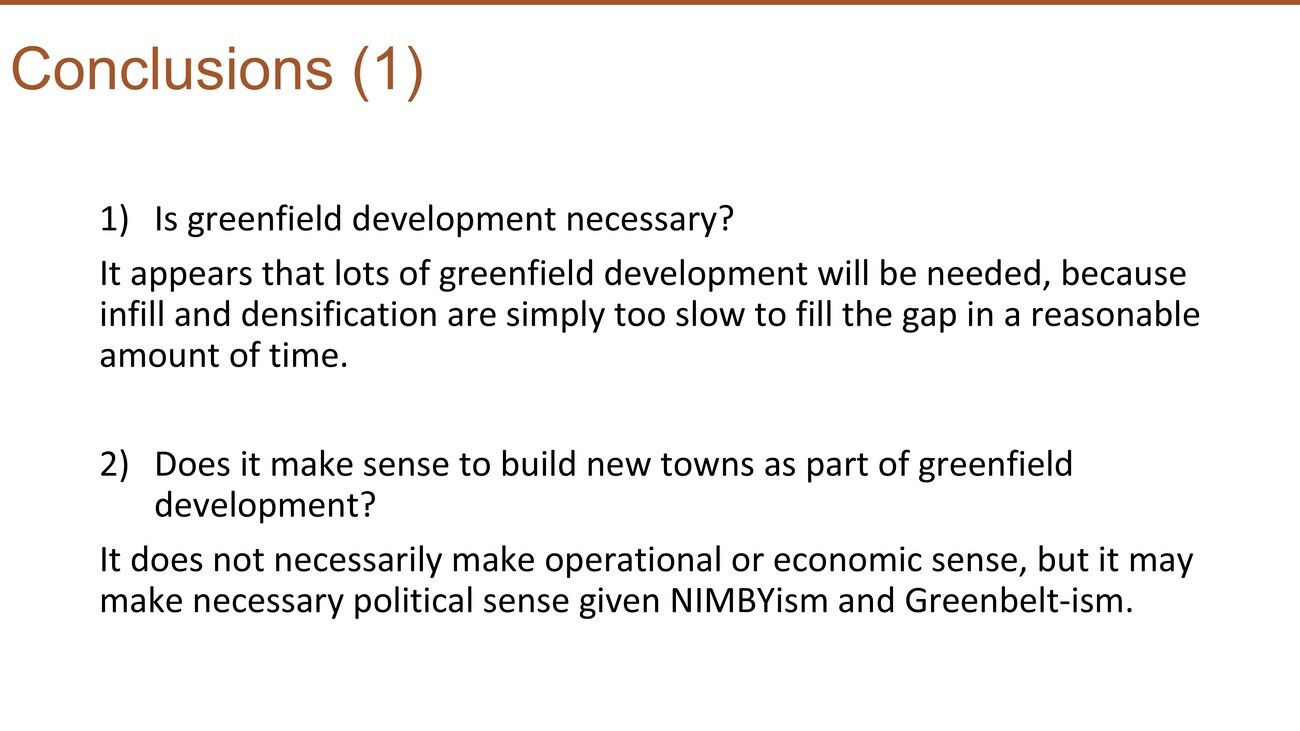
First, is greenfield development necessary? Yes, it seems like it is. Second, does it make sense to build new towns? Given the political realities on the ground, it may make sense to build some new towns.
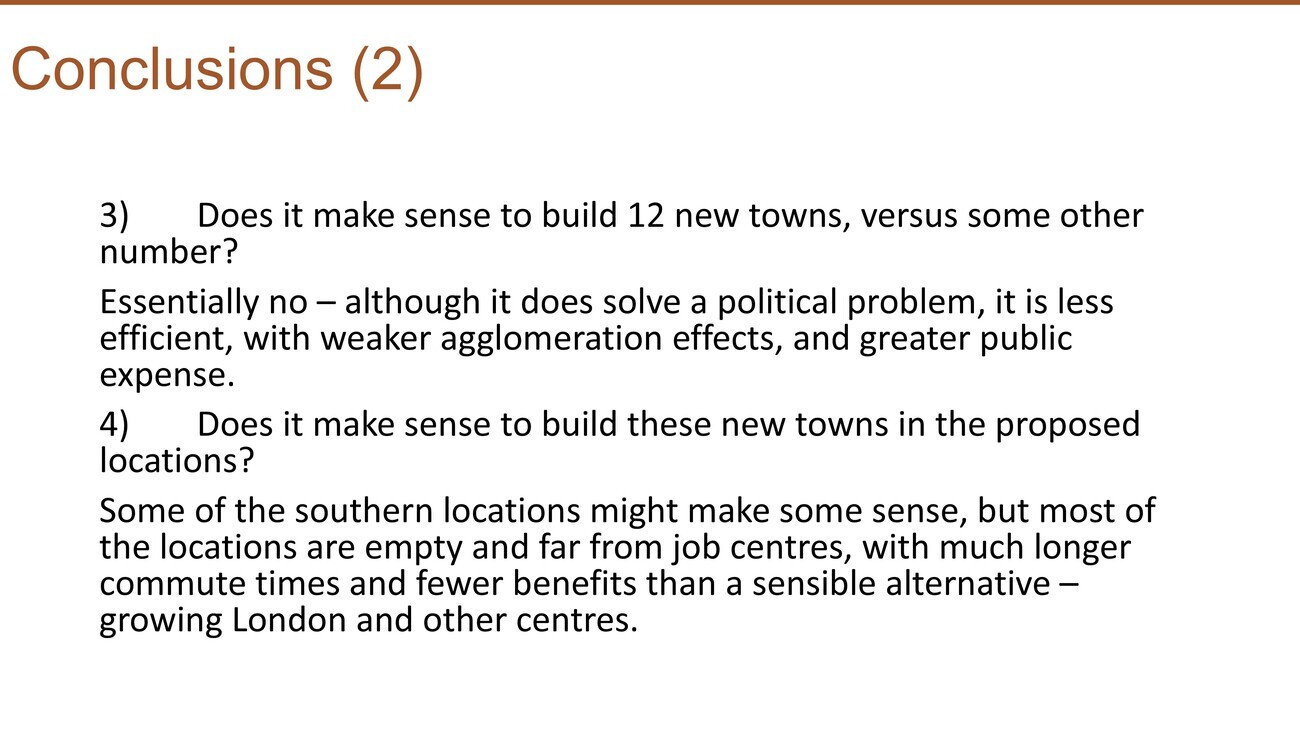
Third, does it make sense to build 12 new towns? Basically it doesn’t. It’s more expensive and it’ll produce worse outcomes than a smaller number of towns. Fourth, does it makes sense to put them in the proposed locations? Some might – but none of the options on the table are as good as the basic solution that the market would provide – letting London grow.
Thank you!
Réutilisation
Citation
@inproceedings{lamson2025,
  author = {Lamson, Patrick},
  publisher = {Sciences Po Rennes \& Villes Vivantes},
  title = {Le programme New Towns : 12 villes nouvelles et 1,5 millions
    de logements neufs pour enrayer la pénurie de logements et libérer
    le potentiel régional de l’Angleterre\,?},
  date = {2025-09-18},
  url = {https://papers.organiccities.co/le-programme-new-towns-12-villes-nouvelles-et-15-millions-de-logements-neufs-pour-enrayer-la-penurie-de-logements-et-liberer-le-potentiel-regional-de-l-angleterre.html},
  langid = {fr}
}